
Every integration answers one question before it answers anything else: when something changes in one system, how does the other system find out? There are three common answers, and most broken integrations picked the wrong one, or picked only one when they needed two.
Here they are in plain English, with when each one fits and what goes wrong with it.
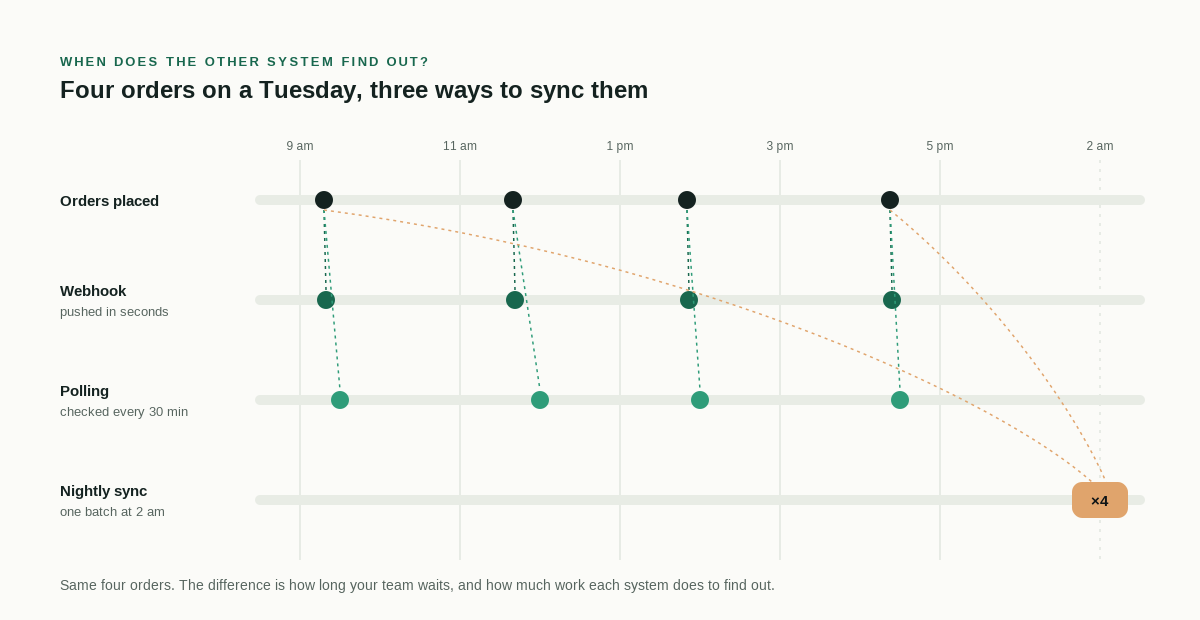
Webhooks: the doorbell
With a webhook, the system where something happened tells the other system, within seconds. Shopify, Stripe, QuickBooks Online and most modern tools can send one when an order is placed, a payment clears or a record changes.
- Strengths: close to real time, and no wasted work checking for changes that didn’t happen.
- Weaknesses: the receiving end has to be online to answer the door, and providers don’t promise every message arrives exactly once, or in order.
Webhook providers retry when they don’t get a quick reply, which means the same event can arrive twice. Every handler must be idempotent: processing the same event a second time has to change nothing. Otherwise a retry creates a duplicate invoice or charges a fee twice.
Polling: checking the mailbox
With polling, your integration asks the other system on a schedule: “anything new since 2:30?” It’s what you use when a system doesn’t send webhooks, or doesn’t send them for the record you care about.
- Strengths: simple, predictable, and nothing is lost if your side was offline for a while; the next check catches up.
- Weaknesses: there’s always a delay, and frequent polling eats into API rate limits even when nothing has changed.
Good polling remembers a cursor, usually the last “modified at” timestamp it saw, and asks only for records changed since then. Bad polling downloads everything every time and slowly gets throttled.
Nightly sync: the weekly delivery
A batch job runs once, usually overnight, and moves everything that changed that day in one go. Many accounting and reporting connections should work this way.
- Strengths: the simplest to build and run, gentle on API limits, and easy to rerun if something goes wrong.
- Weaknesses: nobody sees today’s changes until tomorrow, and one bad record can hold up a whole batch if errors aren’t handled per record.
Side by side
| Webhook | Polling | Nightly sync | |
|---|---|---|---|
| How fast | Seconds | Minutes, set by you | Next morning |
| Load on the API | Low | Medium to high | Low, in one burst |
| If your side is down | Retries, then lost | Catches up next run | Rerun the batch |
| Main risk | Duplicates and missed events | Rate limits | Stale data |
| Good for | Orders, payments, new leads | Systems without webhooks | Accounting, reporting, bulk updates |
The answer is usually two of them
The integrations that hold up in practice combine a fast path with a safety net: webhooks for speed, plus a scheduled sweep that catches anything the webhooks missed.
- Webhooks handle the normal case within seconds.
- Every few hours, or nightly, a sweep asks “what changed since the last sweep?” and fills any gaps.
- Because both paths are idempotent, an event that arrives through both changes nothing the second time.
That design survives the realities of production: a webhook endpoint that was down during a deploy, a provider outage, a message that arrived out of order.
Ask one question per record type: how long can a person wait before a stale copy causes a real problem? Seconds means webhooks plus a sweep. An hour means polling. Tomorrow is fine means a nightly sync.
Questions to ask about any existing integration
- If the receiving system is down for an hour, what happens to the changes made during that hour?
- If the same event arrives twice, do you get two records?
- Where can a person see what synced, what failed and why?
- How close are you to the API’s rate limits on your busiest day?
If nobody can answer these, the integration works until the day it doesn’t, and nobody will know which records went missing.